

192·
1 month agoSee here’s the thing - the mascot and URL are serving their purpose to deter the software author’s outsiders. They don’t want your business, it is a social signal being sent and the reception from your coworker? - did it’s job.
See here’s the thing - the mascot and URL are serving their purpose to deter the software author’s outsiders. They don’t want your business, it is a social signal being sent and the reception from your coworker? - did it’s job.

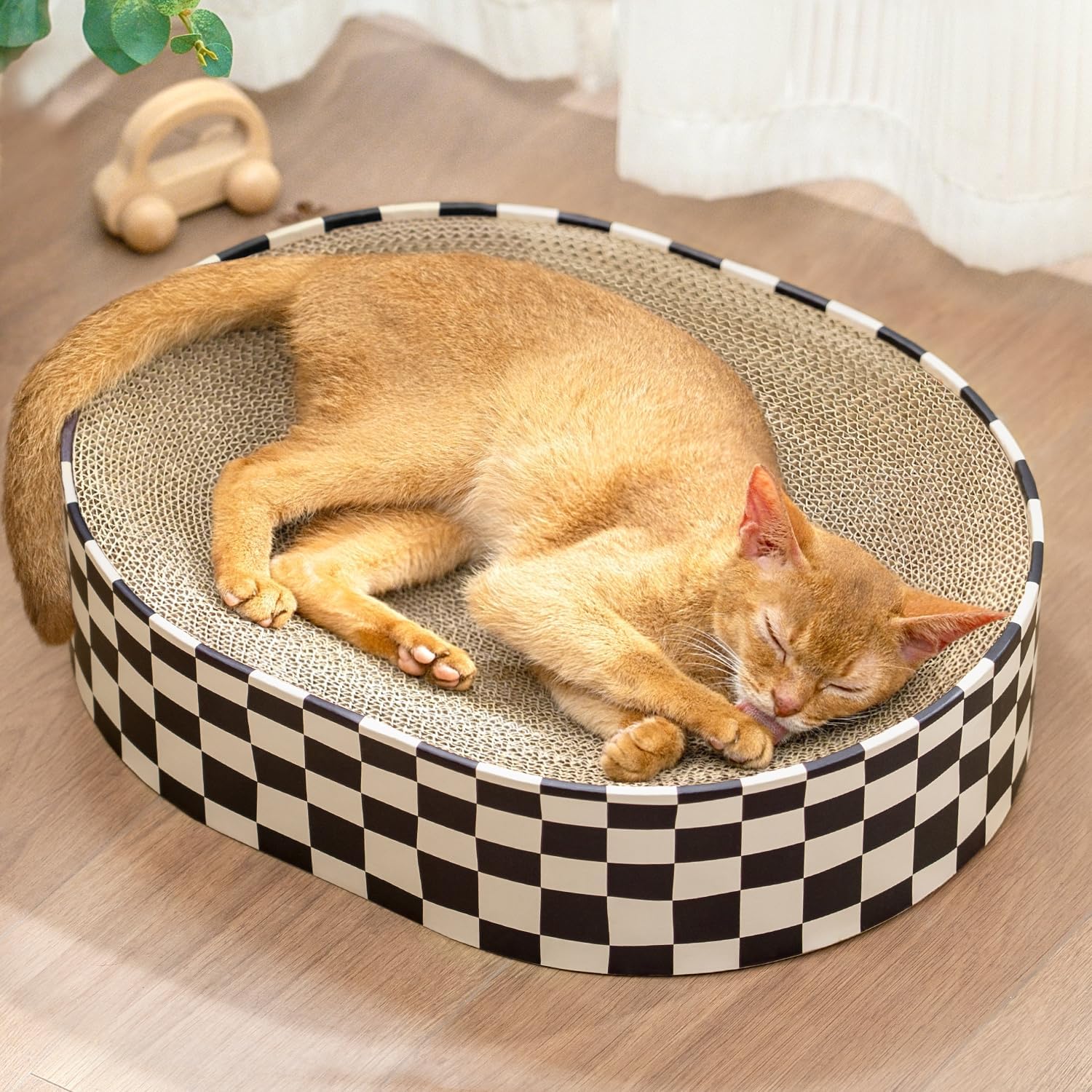
My comment was specifically about these round concave cardboard things - they, their shape and composition, is some weird magnet to the cats. It’s unlike a traditional post, there’s something in their brain that likes these things and they calm down after scratching and curl up in them. I’ve found them in various shapes and depths at Ross, the cats rotate from one to another as sleeping spots and all that cat juju. Here’s a random pic: https://m.media-amazon.com/images/I/81bPWIbZPwL._AC_SL1500_.jpg
One thing I’ve found to work is keeping a string (hoodie cord work great just snip the ends off) coiled up on the desk. They walk in wanting attention and you toss an end at them etc. and they rawr and attack. See if that’s what the lil guy wants.
I’ve also had tremendous luck with the circular cardboard “dish” shaped (concave) scratchers, a modern take on the classic cardboard scratcher. Somehow the act of scratching it then curling up for a nap in it appeals to the cats. Both are snoozing in them as I type 😺
He links it at the end, life imitating art: https://news.ycombinator.com/item?id=49817280
See here’s the thing - to get the ability to downvote / flag articles, you have to say stuff in public enough times to get the 200 (400?) karma to unlock that. Well, how do you get that karma? You say the things that people on that site want to hear so they click upvote. Spot the curricular bias problem? It was intentionally designed this way.
It sounds good but in practice it doesn’t work out; laptops sleep, people put their phones on airplane at night, whatever happens in life. The “best” solutions use some sort of cache-and-forward relay (thinking like DeltaChat relays, or I hear SimpleX is adding them) but I think most end up looking at Snikket (xmpp) or Matrix for the group management etc. on a central server. The Disroot group uses “Movim” which is XMPP highly customized to a social experience.
I use DeltaChat with friends and there’s a lot of things you can’t do because it’s essentially P2P with caching relays - like Jami, all control and data is stored on the device(s). If all you’re looking for is a Signal replacement it’s great (and why we use it), but if you want good group social controls you gotta go the central server route.
I think Jami here could do with caching relays like Delta has, could move this project to the next level.

My bad, I didn’t think of that. My only thought was “$20 says this chucklehead won’t do squat” because we know.
https://grapheneos.social/@GrapheneOS Here you go, argue with GrapheneOS - it’s an open platform, go ahead and make a masto account and share your thoughts with them. Tell them what you think! The rep who handles their masto account is very well spoken and presents rebuttals of value so I advise you bring your A game.
Put HE (dns.he.net) in your back pocket - they run a free DNS service which includes slave (do we still call it that?) service so that you can add their resolver as an ultimate failover / failback if your self hosted DNS takes a dive for whatever reason things break in our world.
Generally, hosting your own DNS “should” mean having a primary and secondary on separate AS networks, or at least different provider routes or locations. But if you’re doing all this from home, where is the second location for DR purposes… exactly? I sure don’t have one, power goes out here everything goes dark - in the old days everyone used to do this (share out tertiary DNS to each other) but it’s become a thing of the past in today’s world. HE can help fill that gap.
To your point - I use Gcore DNS and Bunny DNS for my stuff, as I mainly use online VPSes and don’t run racks of hardware at the house. The only things I physically selfhost at home are a pair of old laptops acting as storage servers which backup all my bytes and bits from online to some SSDs.
I have not tried/used it (yet?), but the kids are building Radicle for this very purpose. It gets a fair amount of techie coverage (blogs, comments, etc.) but sits in unique space compared to, say, Forgejo (classic self-hosted git).

The above said, it wasn’t hard to find a project using XDG and a JSON mapping file (basically your idea fleshed out in python) to get where you want to go if XDG is enough: https://github.com/JonTheNiceGuy/usbrowser
You’re not going to like this answer - there’s a bunch of different ways depending on the app(s) and the desktop environment. The Arch wiki goes over it in detail: https://wiki.archlinux.org/title/Default_applications
I would guess that focusing on the XDG spec and covering Gnome, KDE and Xfce (Xfce can be replaced with anything else like Cinnamon that comes with Mint, “non Gnome or KDE”) is the best plan of attack for what matters to 80%+ of the population.
So close! you have to do cat < foo.txt :-) (/s)
I would assume your system is using systemd (I don’t use Kubuntu specifically); the laptop lid is (now in 2026) controlled by the systemd infrastructure - it’s a matter of setting a config option and this should fix you up. Arch as usual has the best wiki on the subject:
https://wiki.archlinux.org/title/Power_management#ACPI_events
You’re probably looking at HandleLidSwitch* options. There’s still nothing wrong with the manual disable to /proc/acpi/wakeup to cover your bases (layers of the onion), I’m fighting with a “modern” laptop that only has s2idle and it’s terrible compared to S3 - I’m in ACPI wakeup hell and still trying to figure out what’s causing it.
Look, I touched the bride’s butt once at the reception. Never living that down am I?
GenX here, using the 80/20 rule 80% of my friend’s marriages (probably higher %) have ended in divorce. Typically after kids are involved. :-/
I see folks mentioning going back to their dormant LFM accounts. The Metabrainz Foundation has a project ListenBrainz, a more open FOSS style version; if you’re going to spin some scrobbling cycles maybe check it out:
(I stopped scrobbling years ago, privacy concerns)
Stars are just someone’s bookmark (me included) because there’s no simple “bookmark this because I’ll forget in an hour and want to look at it later when I have time.” If one trusts Stars, you’re literally trusting a bookmark that I didn’t put more than 2 seconds of thought into clicking because I have a bad memory. Many I know do the same.
I go straight to code history, show me what the commits look like. One can derive a lot about the project based on just the way the commit messages are written before looking at the code being changed. How the code is changed over time (process, communication, methods, etc.) adds more layers to the qualitative observation. I move on to Issues when I want to see how the devs interact with the users having problems, which is another story.
The dichotomy here is you can’t be famous hosting exploits on smaller forges. Gotta be on the big platforms where you can be starred and forked for social media cred to make news stories to impress your friends. IIRC I think HeartBleed (maybe ShellShock?) was the tip of this popularity iceberg…

Great, now I have an image of two mosquitoes “skol!” as they pierce my skin with big norse proboscisii… 🪰